Buying lithium battery chargers is not a simple matter of matching a plug and a price. The charger must suit the battery’s chemistry, nominal voltage, capacity, connector, and battery management system. A lithium iron phosphate pack needs different charging limits from a standard lithium-ion pack. Using the wrong profile can reduce service life, trigger protection circuits, or create dangerous heat.
Isidor Buchmann, founder of Cadex Electronics and Battery University, explains, “A battery is like a human being. It can handle a certain amount of stress, but too much will shorten its life.” That principle should guide every purchase. Look for accurate voltage control, suitable charging current, temperature monitoring, and clear manufacturer specifications. Check whether the charger supports balancing when the battery pack requires it. Also inspect the cable, plug fit, ventilation, and visible quality. Small details matter.
This guide presents 10 practical tips for choosing lithium battery chargers with greater confidence. It considers charging speed, compatibility, safety certifications, warranty support, energy efficiency, and everyday convenience. A fast charger may appear attractive, but speed is not always the best choice. A cooler, slower charge can be kinder to a frequently used battery. Marketing claims can also sound more impressive than they are. Read the technical label carefully. Compare the charger with the battery manual, not just an online product image. No checklist is perfect. Still, careful questions can prevent an expensive mistake.
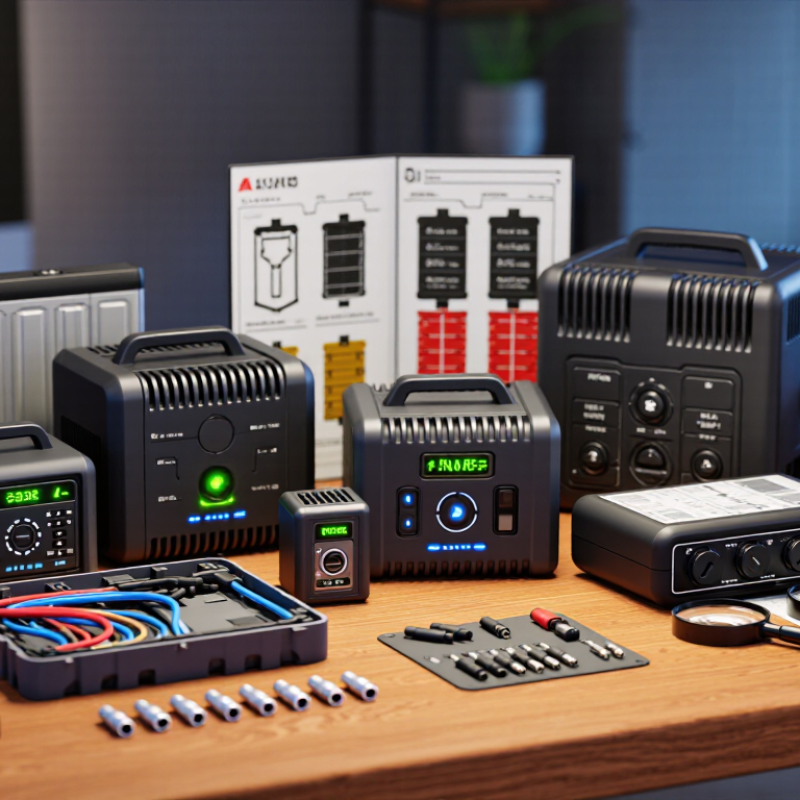
Before buying a lithium battery charger, identify the battery’s exact chemistry, voltage, and capacity. Lithium-ion and lithium iron phosphate batteries need different charging profiles. Their full-charge voltages are not interchangeable. A “12-volt” battery may require a higher charging voltage than expected. Capacity also matters. Do not guess. Read the battery label, datasheet, or manufacturer’s charging instructions.
Choose a charger that uses constant-current and constant-voltage charging. Its output voltage must match the battery’s specified limit. Charging current should fit the battery’s capacity and battery management system. A lower current usually creates less heat, but charging takes longer. Check the connector size and polarity carefully. Look for protection against overvoltage, overcurrent, short circuits, and excessive temperature. Some battery packs also require temperature sensing or communication with their management system. A basic charger may not support these functions.
I once assumed that a higher-current charger would simply save time. That assumption was wrong. Heat increased, and the battery needed closer monitoring. Now I compare charger specifications with the battery’s charging limits before purchase. I also inspect the cable, casing, ventilation openings, and safety test information. A multimeter can help verify output voltage, but it cannot replace proper charging guidance. If the specifications conflict, pause and ask a qualified technician. Small details matter.
A charger is not automatically suitable because its plug fits. Match its output voltage to the battery pack’s required charging voltage. A 12-volt lithium-ion pack may require 12.6 volts, while a lithium iron phosphate pack may require a different limit. Check the battery label, manual, or manufacturer’s technical sheet before purchasing. Small voltage differences matter.
Charging current also needs careful attention. A battery rated for 5 amperes should not be forced to accept 10 amperes without clear approval. Higher current can shorten battery life, increase heat, or trigger protection circuits. Lower current is usually slower, but often gentler. I once focused too much on charging speed and nearly overlooked the battery’s permitted current range. That was a useful mistake.
Battery chemistry controls the charging method. Standard lithium-ion, lithium polymer, and lithium iron phosphate batteries can have different voltage limits and charging profiles. A suitable charger should use the correct constant-current and constant-voltage process for that chemistry. Confirm connector polarity, plug size, and temperature requirements as well. Never rely only on color coding. If the specifications conflict, pause and ask the battery supplier for written clarification. A charger with the correct voltage can still be unsafe when its chemistry setting is wrong. Check the numbers twice.
Buying a lithium battery charger starts with the connector, not the advertised wattage. A plug can fit and still have reversed polarity, unsuitable pins, or poor contact pressure. Check diameter, pin layout, polarity, locking method, and rated current. I once trusted a matching barrel plug; that shortcut was wrong. The battery became warm during charging, so I stopped and checked the specifications.
Industry growth makes this check less optional. The IEA’s Global EV Outlook 2024 reported nearly 14 million electric cars sold in 2023, increasing demand for compatible charging equipment. For smaller packs, IEC 62133-2 remains a key safety reference for rechargeable lithium cells and batteries. A reputable charger should state output voltage, current, connector pinout, and protection functions. “Universal” is not a technical specification. It is a warning to investigate.
Then verify the charging protocol. Lithium cells generally require controlled constant-current and constant-voltage charging. Some packs also require communication with a battery-management system. The USB Implementers Forum states that USB Power Delivery can negotiate up to 240 watts under its Extended Power Range specification. However, the connector alone does not guarantee that capability. Compare the charger’s voltage profile with the battery label and technical data. Do not rely on color codes. My own mistake was assuming higher current meant faster, safer charging; temperature, cell balance, and termination control mattered more.
| Tip | Key Buying Check | Relevant Technical Data | Why It Matters | Recommended Action |
|---|---|---|---|---|
| 1 | Confirm the battery chemistry | Common lithium rechargeable chemistries include lithium-ion and lithium iron phosphate. Their full-charge voltages are different: approximately 4.20 V per cell for many lithium-ion cells and approximately 3.65 V per cell for many lithium iron phosphate cells. | A charger designed for one chemistry may overcharge or undercharge another chemistry, creating a safety risk or reducing battery performance. | Read the battery label or technical datasheet and select a charger explicitly specified for the exact chemistry. Do not rely only on the word “lithium.” |
| 2 | Match the battery voltage and series count | Charging voltage depends on the number of cells connected in series. For example, a typical 3-cell lithium-ion pack requires about 12.6 V at full charge, while a typical 4-cell pack requires about 16.8 V. | An incorrect output voltage can prevent a full charge or exceed the battery’s allowable voltage. | Match the charger’s rated output voltage to the battery pack’s specified charging voltage, not merely to its nominal voltage. |
| 3 | Verify connector compatibility | Check the connector type, plug dimensions, contact arrangement, mating gender, locking method, and whether the connector carries power, balance, or communication signals. | Two plugs can look similar while having different pin assignments or electrical functions. A mismatch can cause no charging, short circuits, or equipment damage. | Compare the connector drawing and pinout with the battery documentation. Never force a plug into a socket or assume that physical fit means electrical compatibility. |
| 4 | Check polarity and pinout | For a basic DC charging connection, positive and negative terminals must be correctly identified. Multi-pin connectors may also include temperature-sensor, enable, balance, or data pins. | Reversed polarity or incorrect pin wiring can damage the charger, battery, or connected equipment. | Use the manufacturer-provided wiring diagram or verify the pins with suitable test equipment before connecting. Do not depend on wire color alone. |
| 5 | Select the correct charging protocol | Most lithium-ion battery chargers use a constant-current/constant-voltage method. Some battery systems also require communication, authentication, or a charger-enable signal before current is delivered. | A voltage-only power supply may not provide the required current control or system communication and should not automatically be treated as a battery charger. | Confirm whether the battery requires standalone CC/CV charging, a balance charger, or a communication-enabled charging system. |
| 6 | Choose a suitable charging current | Charging current is normally specified in amperes or as a C-rate. A 1C rate means a theoretical full charge in about one hour, although the constant-voltage phase makes the actual time longer. | Excessive current can cause overheating, accelerated aging, or a battery-management-system shutdown. A lower current is generally slower but may be permitted by the battery specification. | Stay within the battery’s specified maximum charging current. Consider a lower-current charger when thermal conditions, battery age, or operating conditions require additional margin. |
| 7 | Confirm BMS and balance requirements | A battery-management system may protect against overvoltage, undervoltage, overcurrent, and overtemperature. Multi-cell packs may also require cell balancing through dedicated balance connections or internal circuitry. | A charger alone cannot correct an unsuitable pack design or replace all BMS functions. Unbalanced cells can reach different voltages during charging. | Determine whether balancing is internal to the battery or requires an external balance charger. Do not bypass the BMS or balance connector unless the battery documentation specifically permits it. |
| 8 | Review temperature limits | Many lithium battery systems inhibit charging below 0°C unless specifically designed for low-temperature charging. Charging temperature limits vary by chemistry, cell design, and battery-management system. | Charging a cold lithium battery can cause permanent damage, including lithium plating. High temperatures can also increase degradation and safety risks. | Check the permitted charging-temperature range and use the battery’s temperature-sensing or thermal-control features when required. |
| 9 | Evaluate charger protection features | Useful protections include output overvoltage, short-circuit, overcurrent, overtemperature, reverse-polarity, and end-of-charge termination. A visual charge-status indicator can also help monitor operation. | Protection features reduce the likelihood of damage caused by wiring errors, abnormal loads, blocked ventilation, or charging faults. | Review the charger’s protection specifications and operating manual. Treat vague claims such as “smart” or “universal” as insufficient technical information. |
| 10 | Check electrical safety and operating conditions | Verify the input voltage and frequency, output rating, enclosure or ingress protection, ventilation requirements, cable temperature rating, and applicable electrical-safety testing or certification for the intended region. | A charger suitable for indoor use may not be suitable for vehicles, workshops, outdoor locations, or damp environments. Poor ventilation can increase operating temperature. | Use the charger only within its specified environment, keep ventilation openings clear, inspect cables regularly, and stop charging if the battery becomes swollen, unusually hot, damaged, or emits an odor. |
Lithium battery chargers deserve more scrutiny than a low price tag suggests. The International Energy Agency’s Global EV Outlook 2024 reported nearly 14 million electric car sales in 2023, while global public charging points exceeded four million. More chargers also mean more poorly designed products entering homes, workshops, and garages.
Check the safety label closely. Look for standards matching the battery chemistry, voltage, and charging method, such as IEC 62133-2 for rechargeable lithium batteries or IEC 61851 for conductive vehicle charging. Certification marks should be traceable through an official database. A printed logo is not proof. The charger should provide overcharge, overcurrent, short-circuit, and over-temperature protection. I prefer models that stop charging cleanly, rather than becoming hot beside a wooden workbench. Small detail, big consequence.
Build quality appears in the cable, plug, ventilation slots, and strain relief. A stiff cable may crack after repeated bending. Loose connectors can create heat at the contact point. The U.S. Consumer Product Safety Commission has repeatedly warned that lithium battery incidents often involve overheating, fires, or thermal runaway. Do not ignore those warnings. I still inspect chargers after purchase, because certification cannot prevent every misuse or manufacturing defect. Some buyers, including me, trust impressive packaging too quickly. That habit needs questioning. A clear manual, readable ratings plate, replaceable fuse, and realistic warranty usually reveal more than polished marketing.
Evaluate safety features, certifications, and build quality before selecting a charger. The chart shows typical maximum charge voltage per cell for common lithium battery chemistries.
Buying guidance: Use a charger designed for the battery’s exact chemistry and cell count. A lithium-ion or lithium-polymer cell commonly charges to 4.20 V, LiFePO₄ to about 3.65 V, and lithium-titanate to about 2.80 V. Look for appropriate safety certifications such as IEC 60335-2-29 or UL 62368-1 where applicable, plus overcharge, short-circuit, over-temperature, and reverse-polarity protection. Solid enclosures, strain relief, insulation, and adequate ventilation are also important indicators of build quality.
Compare Charging Speed, Reliability, Price, and Warranty
A fast charger is useless if its output does not fit your battery. Check the label carefully. I once focused on charging time and overlooked connector compatibility. That mistake delayed a project.
Higher current can reduce waiting, but it may create more heat. Look for temperature control, overcharge protection, short-circuit protection, and stable power delivery. A charger that finishes quickly but runs excessively hot deserves caution. Test it in a ventilated area and touch the casing during normal use. Warm is common. Uncomfortably hot is different.
Thick cables, secure connectors, clear instructions, and a durable casing are useful details. Do not trust impressive claims alone. Ask whether the charger has been tested under repeated charging cycles. Real experience can reveal weaknesses that specifications hide.
A cheap charger may need replacement sooner or include a fragile cable. A higher-priced model can be better value if it offers safer components and longer service. Still, expensive does not automatically mean reliable.
Check its length, coverage, proof-of-purchase rules, and replacement process. A clear warranty shows accountability, though it cannot fix poor everyday performance. I would record the purchase date and keep the instructions. Small habits help.
An exceptional record of quality and service for 35+ years.
© 2026 Excell Battery Co. All rights reserved.Privacy Statement