
A lithium ion car battery is the quiet power source behind most modern electric vehicles. It stores electrical energy through reversible chemical reactions. When the vehicle accelerates, lithium ions move through an electrolyte from the negative electrode to the positive electrode. Electrons travel through the external circuit instead, powering the motor. During charging, this movement reverses.
The scale is significant. The International Energy Agency’s Global EV Outlook 2024 reported more than 14 million electric car sales worldwide in 2023. It also estimated that electric vehicle battery demand exceeded 750 GWh that year. BloombergNEF’s 2024 Battery Price Survey placed the average lithium-ion pack price at $115 per kWh, although prices vary by region, chemistry, and vehicle design. These figures show why battery engineering matters beyond driving range. A few kilograms of active material can influence cost, acceleration, safety, and climate performance.
Inside the pack, hundreds or thousands of cylindrical, prismatic, or pouch cells work together. A battery management system monitors voltage, temperature, and state of charge. It can isolate a faulty section before a small problem becomes serious. Thermal management may use air, liquid coolant, or both. The U.S. Department of Energy notes that battery life depends on temperature, charging behavior, depth of discharge, and operating conditions. Real-world results still differ. A cold morning, a steep hill, or repeated fast charging can change performance noticeably. No single specification tells the whole story. This guide explains the chemistry, components, charging process, safety controls, and practical limitations of a lithium ion car battery, while recognizing that battery technology continues to evolve.
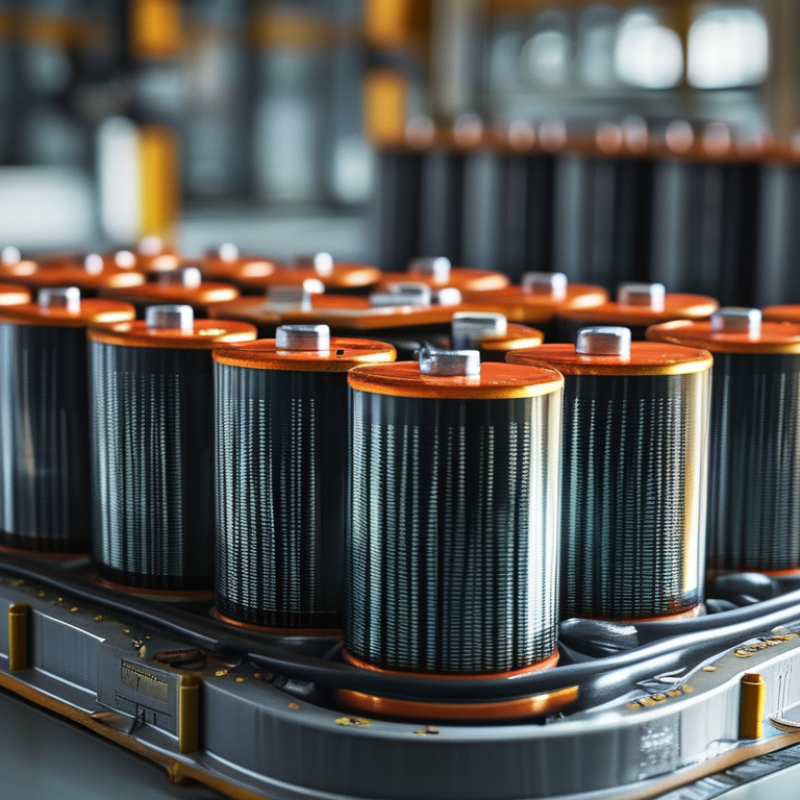
What Is a Lithium-Ion Car Battery and How Does It Work?
A lithium-ion EV battery is a layered electrical system, not one oversized battery. Inside, individual cells store energy through chemical reactions between electrodes and an electrolyte. Cells connect in series to raise voltage and in parallel to increase capacity. A typical cell produces about 3.6–3.7 volts, so hundreds of cells may support a 400–800 V vehicle system. Small parts matter.
Cells are grouped into modules, although some newer designs reduce or remove separate module sections. Modules sit inside a sealed battery pack with cooling plates, sensors, busbars, fuses, and a battery-management system. The management system measures voltage, temperature, and state of charge. It also limits current when conditions become unsafe. Heat is unforgiving. Poor temperature control can reduce charging speed and shorten battery life.
Industry data shows the scale of this technology. The International Energy Agency reported that global electric-car battery demand reached about 750 GWh in 2023, increasing roughly 40% year over year. BloombergNEF’s 2023 Battery Price Survey placed the average lithium-ion pack price at 139 dollars per kWh. These figures describe an industry moving toward higher energy density and lower costs, but they do not guarantee equal real-world performance. Climate, driving habits, charging patterns, and aging still matter. The neat diagram hides difficult engineering compromises. A larger pack can extend range, yet it adds weight, cooling demand, and manufacturing complexity.
| Battery Element | What It Is | Typical Electrical Data | How It Works in an EV | Key Engineering Considerations |
|---|---|---|---|---|
| Lithium-Ion Cell | The smallest rechargeable electrochemical unit, usually constructed with a positive electrode, negative electrode, separator, electrolyte, and current collectors. | Typical nominal voltage: 3.2–3.7 V Typical capacity: 20–100 Ah Energy example: a 3.7 V, 100 Ah cell stores approximately 370 Wh. |
Lithium ions move between the two electrodes during charging and discharging, while electrons flow through the external circuit to power the vehicle. | Cell chemistry, electrode design, temperature, charge rate, and operating voltage affect energy, power, service life, and safety. |
| Positive Electrode | The electrode that accepts lithium ions during discharge and releases them during charging. Common material families include layered metal oxides, phosphate-based compounds, and manganese-rich oxides. | Its voltage and capacity depend on the selected chemistry. Phosphate-based cells commonly have a nominal voltage near 3.2 V, while several oxide-based cells are near 3.6–3.7 V. | It contributes to the cell's voltage, energy density, thermal behavior, and maximum usable power. | Material stability, thermal characteristics, cost, and the desired balance between energy density and cycle life must be considered. |
| Negative Electrode | Usually made from graphite or a graphite-based composite, with some advanced designs incorporating silicon-containing materials. | It stores lithium during charging and releases lithium during discharge. Its usable capacity and charging limits depend strongly on temperature and current. | It provides the electron source during discharge and receives electrons from the charging system during recharge. | Fast charging at low temperatures can cause lithium plating, which may reduce capacity and increase safety risks. |
| Separator and Electrolyte | The separator is a porous insulating membrane between the electrodes. The electrolyte enables lithium-ion movement but prevents direct electronic contact. | The separator is typically only tens of micrometers thick. The electrolyte is usually an organic liquid containing a lithium salt. | They allow ionic conduction inside the cell while keeping the positive and negative electrodes electrically separated. | Separator integrity, electrolyte stability, moisture control, and resistance to internal short circuits are essential for safe operation. |
| Cell Formats | The three main physical formats are cylindrical, prismatic, and pouch cells. | Electrical performance is determined mainly by chemistry and design rather than shape. Physical dimensions, terminal configuration, and cooling interfaces vary by format. | The format determines how cells are packaged, connected, cooled, inspected, and serviced within a module or pack. | Cylindrical cells offer standardized mechanical structures; prismatic cells use rigid cases; pouch cells can be lightweight but require external compression and protection. |
| Series Connection | Cells connected positive-to-negative in a chain to increase voltage. | For cells with a 3.7 V nominal voltage: 96 cells in series provide approximately 355 V nominal. 192 cells in series provide approximately 710 V nominal. |
Series connections create the high-voltage operating range needed by the traction inverter and electric motor. | Every cell in the series chain must remain within its permitted voltage range; imbalance can reduce usable energy and increase risk. |
| Parallel Connection | Cells or cell groups connected positive-to-positive and negative-to-negative to increase capacity and current capability. | Two identical 3.7 V, 100 Ah cells in parallel produce approximately 3.7 V and 200 Ah, or about 740 Wh. | Parallel groups allow the battery to deliver more current and store more energy without increasing the voltage of that group. | Cells connected in parallel should have closely matched voltage, capacity, resistance, age, and temperature characteristics. |
| Battery Module | A mechanically supported group of cells with electrical interconnections, sensing components, insulation, and often a dedicated cooling interface. | Module voltage commonly ranges from approximately 20–100 V, depending on the number of cells connected in series. | Modules simplify manufacturing, assembly, monitoring, thermal management, and service compared with handling every cell individually. | Busbars, fuses, compression structures, temperature sensors, and electrical isolation must be designed to withstand vibration and fault conditions. |
| Battery Pack | The complete high-voltage energy-storage assembly, including cells or modules, enclosure, cooling system, sensors, contactors, fuses, and control electronics. | Typical passenger-EV pack energy: approximately 40–120 kWh. Nominal system voltage commonly falls in the 300–450 V or 600–800 V class. |
It stores electrical energy and supplies controlled DC power to the inverter, onboard charger, auxiliary systems, and other high-voltage loads. | Structural protection, crash safety, sealing, thermal propagation resistance, service isolation, mass, and underbody packaging are major design requirements. |
| 400 V-Class System | A high-voltage architecture built around a pack whose nominal voltage is commonly in the low-to-mid 300 V range, although the charging voltage is higher. | A representative arrangement is 96 series-connected cells at 3.7 V nominal, producing approximately 355 V nominal and about 403 V at 4.2 V per cell. | It provides a practical balance of component availability, insulation requirements, current capability, and system cost. | For the same power level, current is roughly twice that of an 800 V-class system, increasing conductor and connector current demands. |
| 800 V-Class System | A higher-voltage architecture that reduces current for a given power output and is commonly used for high-power traction and charging designs. | A representative arrangement is 192 series-connected cells at 3.7 V nominal, producing approximately 710 V nominal and about 806 V at 4.2 V per cell. | At the same power, the higher voltage reduces current, which can lower cable losses and support smaller conductors or higher charging power. | Higher voltage requires stricter insulation, creepage and clearance distances, arc control, isolation monitoring, and service procedures. |
| Battery Management System | An electronic control system that measures cell and pack voltage, temperature, current, insulation status, and state estimates. | It monitors individual series-cell groups and controls allowable charge and discharge current according to operating conditions. | It protects the battery from overcharging, excessive discharge, overcurrent, overheating, and cell imbalance. | State-of-charge and state-of-health estimates depend on calibrated models, sensor accuracy, temperature, aging, and usage history. |
| Cell Balancing | A control process that reduces voltage or state-of-charge differences between cells connected in series. | Passive balancing commonly dissipates excess energy as heat, while active balancing transfers energy between cells or cell groups. | Balancing helps the pack use more of its available capacity without allowing one cell to reach its voltage limit prematurely. | Balancing current, balancing speed, heat generation, and the acceptable level of cell mismatch affect pack efficiency and longevity. |
| Thermal Management | A system that removes heat during high-power operation and may warm the battery during cold conditions. | Many lithium-ion batteries operate most efficiently within an approximate cell temperature range of 15–35 °C, while allowable limits vary by chemistry and design. | Cooling plates, channels, refrigerant loops, heat exchangers, or air systems help maintain consistent cell temperature and reduce performance variation. | Temperature uniformity is important because hot or cold cells age differently and may have different power and charging limits. |
| Contactors and Pre-Charge Circuit | High-voltage switches and a resistor-controlled circuit that connect the battery to the vehicle's electrical system. | Contactors must interrupt high DC voltage and current. The pre-charge circuit limits the initial current used to charge inverter and DC-link capacitors. | They keep the pack electrically isolated when the vehicle is off or when a fault is detected, then connect it in a controlled sequence. | Arc suppression, weld detection, fault response time, insulation monitoring, and emergency disconnect behavior are critical safety factors. |
| Usable Energy | The portion of total stored energy that the vehicle allows the driver to access during normal operation. | Pack energy is approximated by nominal voltage × ampere-hours. Usable energy is lower than gross energy because of operating limits and reserve capacity. | The vehicle control system maintains an upper and lower energy buffer to support performance, protect the cells, and reduce aging. | Temperature, current demand, battery age, state of charge, and charging strategy all influence real-world usable energy and driving range. |
| Charging and Discharging | Charging converts electrical energy into chemical energy; discharging reverses the process to supply the motor and vehicle systems. | Charging limits are expressed using current, voltage, and C-rate. A 1C charge rate would theoretically charge a fully discharged 100 Ah cell at 100 A in about one hour, excluding losses. | During acceleration, the pack sends DC power to the inverter. During regenerative braking, the inverter sends controlled electrical power back to the pack. | Maximum power is limited by cell temperature, state of charge, voltage, cooling capacity, connector rating, and battery aging. |




An exceptional record of quality and service for 35+ years.
© 2026 Excell Battery Co. All rights reserved.Privacy Statement